

Dissolving Pulp Market In 2029
dissolving pulp market demand

dissolving pulp market analysis
dissolving pulp market forecast
The Business Research Company's Dissolving Pulp Market In 2029
LONDON, GREATER LONDON, UNITED KINGDOM, January 12, 2026 /EINPresswire.com/ -- "Dissolving Pulp Market to Surpass $23 billion in 2029. Within the broader Paper, Plastics, Rubber, Wood And Textile industry, which is expected to be $9,585 billion by 2029, the Dissolving Pulp market is estimated to account for nearly 0.2% of the total market value.
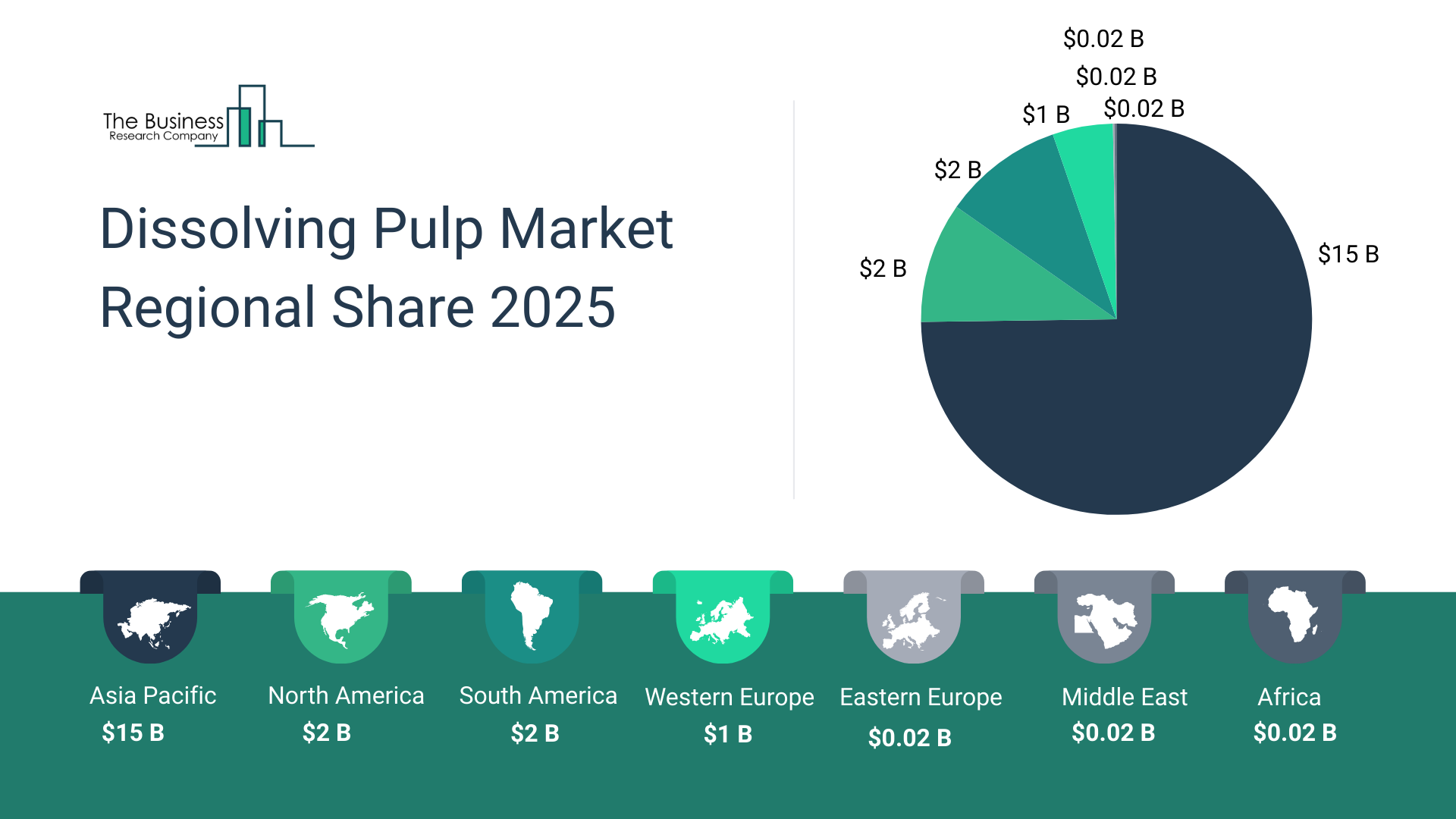
Which Will Be the Biggest Region in the Dissolving Pulp Market in 2029
Asia Pacific will be the largest region in the dissolving pulp market in 2029, valued at $17,860 million. The market is expected to grow from $14,242 million in 2024 at a compound annual growth rate (CAGR) of 5%. The steady growth can be attributed to the growing apparel and fast-fashion volumes and consumer shift toward sustainable or biobased fibers.
Which Will Be The Largest Country In The Global Dissolving Pulp Market In 2029?
China will be the largest country in the dissolving pulp market in 2029, valued at $11,507 million. The market is expected to grow from $9,647 million in 2024 at a compound annual growth rate (CAGR) of 4%. The steady growth can be attributed to the consumer shift toward sustainable or biobased fibers and growing demand for bio-based polymers and films.
Request a free sample of the Dissolving Pulp Market report:
What will be Largest Segment in the Dissolving Pulp Market in 2029?
The dissolving pulp market is segmented by source into wood pulp, cotton linters, bamboo pulp and other sources. The wood pulp market will be the largest segment of the dissolving pulp market segmented by source, accounting for 79% or $18,115 million of the total in 2029. The wood pulp market will be supported by abundant global availability of wood as a raw material, established supply chains from forestry industries, rising demand for wood-based cellulose in textile production, increasing use in high-strength viscose rayon, preference for sustainably sourced FSC-certified wood and favourable government policies supporting plantation forestry.
The dissolving pulp market is segmented by application into textiles, food and beverages, pharmaceuticals, personal care, industrial applications and other applications. The textiles market will be the largest segment of the dissolving pulp market segmented by application, accounting for 68% or $15,644 million of the total in 2029. The textiles market will be supported by rising demand for viscose rayon and lyocell fibers, increasing consumer preference for sustainable and biodegradable fabrics, growth in global apparel and fashion industries, expansion of textile manufacturing in Asia-Pacific countries, innovations in blended fabrics requiring dissolving pulp and rising adoption of eco-labelled clothing lines.
The dissolving pulp market is segmented by grade into specialty grade and technical grade. The specialty grade market will be the largest segment of the dissolving pulp market segmented by grade, accounting for 71% or $16,234 million of the total in 2029. The specialty grade market will be supported by high purity requirements in pharmaceutical and food applications, increasing demand for cellulose in performance-enhancing specialty papers, growth of sustainable textile fibers with superior quality standards, expansion of high-value derivatives such as nitrocellulose, strong adoption in medical and cosmetic formulations and willingness of industries to pay premium for quality and consistency.
The dissolving pulp market is segmented by production process into prehydrolysis kraft process, acid sulfite process and other production processes. The prehydrolysis kraft process market will be the largest segment of the dissolving pulp market segmented by production process, accounting for 63% or $14,384 million of the total in 2029. The prehydrolysis kraft process market will be supported by production of high-purity pulp with consistent quality, strong adoption in textile-grade cellulose production, ability to handle multiple raw materials including hardwood and softwood, alignment with sustainable forestry practices, compatibility with large-scale commercial production and preference from manufacturers for reliability and efficiency.
What is the expected CAGR for the Dissolving Pulp Market leading up to 2029?
The expected CAGR for the dissolving pulp market leading up to 2029 is 5%.
What Will Be The Growth Driving Factors In The Global Dissolving Pulp Market In The Forecast Period?
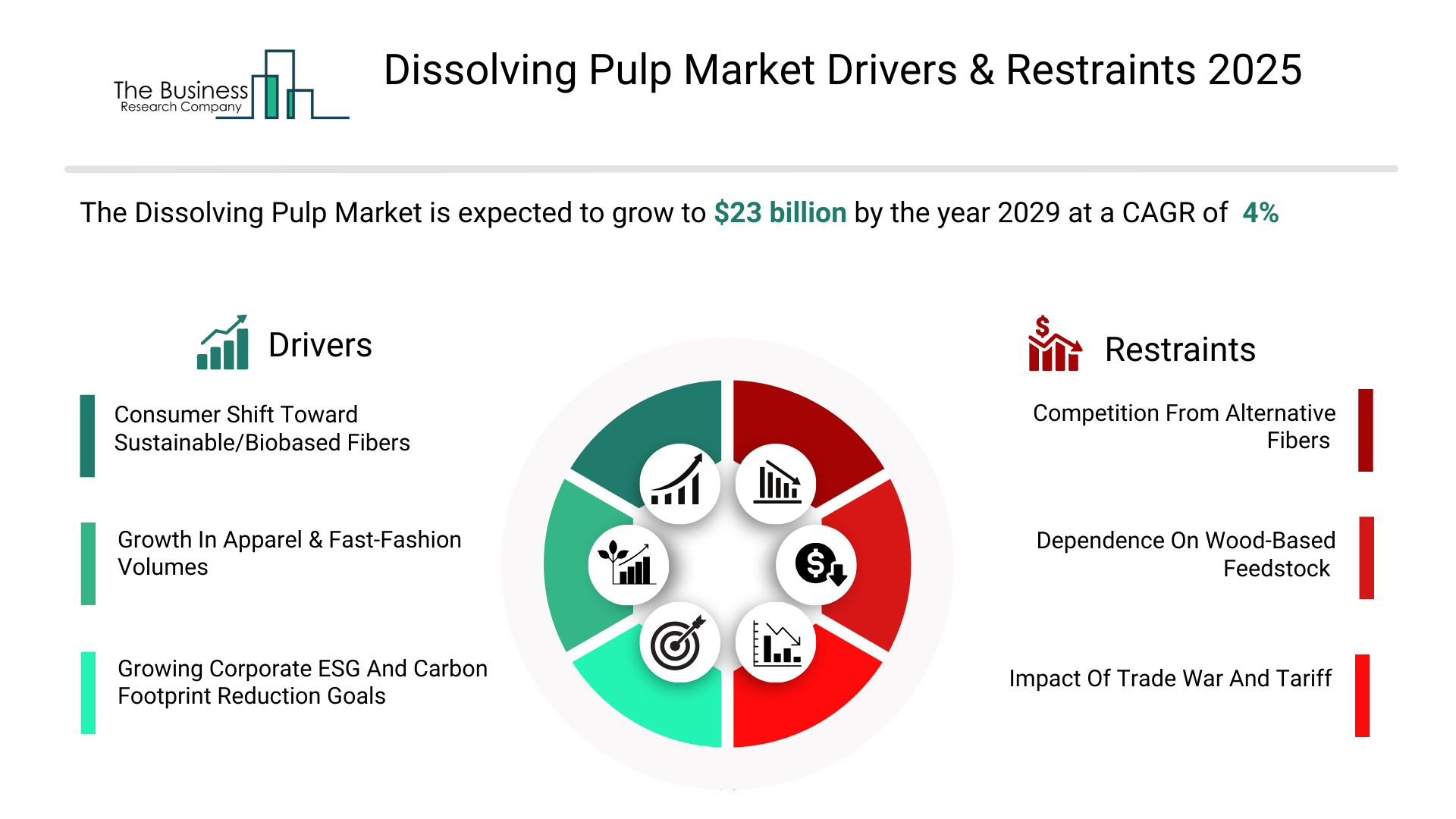
The rapid growth of the global dissolving pulp market leading up to 2029 will be driven by the following key factors that are expected to reshape sustainable materials production, textile manufacturing, and bio-based chemical value chains worldwide.
Consumer Shift Toward Sustainable/Biobased Fibers - The consumer shift toward sustainable/biobased fibers will become a key driver of growth in the dissolving pulp market by 2029. Dissolving pulp is the primary raw material used in the production of regenerated cellulose fibers such as viscose, lyocell and modal. As consumers increasingly prefer sustainable clothing over synthetic fibers like polyester, demand for bio-based fibers grows, creating a positive push for dissolving pulp. As consumers become more conscious of the environmental impact of their purchases, the demand for apparel made from sustainable and bio-based fibers is expected to rise, driving the industry towards more sustainable practices and dissolving pulp. As a result, the consumer shift toward sustainable/biobased fibers is anticipated to contributing to a 1.3% annual growth in the market.
Growth In Apparel & Fast-Fashion Volumes - The growth in apparel & fast-fashion volumes will emerge as a major factor driving the expansion of the dissolving pulp market by 2029. Dissolving pulp is a key raw material for manufacturing cellulose-based fibers such as viscose, lyocell and modal. With the global fast-fashion industry pushing for high-volume, low-cost textiles, demand for viscose fiber has surged. This drives higher consumption of dissolving pulp as textile producers seek cost-effective and scalable raw materials. As the apparel and fast-fashion sectors continue to grow, the need for innovative and efficient fiber solutions is expected to rise, thereby propelling the dissolving pulp market forward. Consequently, the growth in apparel & fast-fashion volumes capabilities is projected to contributing to a 1.0% annual growth in the market.
Growing Corporate ESG And Carbon Footprint Reduction Goals - The growing corporate ESG and carbon footprint reduction goals will serve as a key growth catalyst for the dissolving pulp market by 2029. Companies and industries are under growing pressure from stakeholders, including investors, regulators and consumers, to adopt environmentally responsible practices that reduce greenhouse gas emissions. Sustainable packaging materials, such as biodegradable films and recyclable polymers, help corporations meet these ESG and carbon reduction targets while maintaining product integrity and functionality. Dissolving pulp, derived from renewable wood sources, is being positioned as a sustainable alternative to fossil-fuel-based materials such as polyester in textiles or plastics in packaging. This alignment makes dissolving pulp a preferred input for companies aiming to reduce Scope 3 emissions in their supply chains. Therefore, this growing corporate ESG and carbon footprint reduction goals operations is projected to supporting to a 0.8% annual growth in the market.
Growing Demand For Bio-Based Polymers And Films - The growing demand for bio-based polymers and films will become a significant driver contributing to the growth of the dissolving pulp market by 2029. Industries are increasingly adopting cellulose-derived products, such as rayon, viscose and specialty cellulose, which offer biodegradability and a reduced environmental footprint. Dissolving pulp provides practical benefits by enabling high-quality fiber production, offering excellent chemical purity and complying with emerging environmental regulations. With consumers and governments worldwide pushing for sustainable alternatives to petroleum-based materials, the use of dissolving pulp in textiles, packaging and specialty applications is expanding rapidly, thereby fuelling market growth. Consequently, the growing demand for bio-based polymers and films strategies is projected to contributing to a 0.5% annual growth in the market.
Access the detailed Dissolving Pulp Market report here:
What Are The Key Growth Opportunities In The Dissolving Pulp Market in 2029?
The most significant growth opportunities are anticipated in the specialty dissolving pulp market, wood dissolving pulp market, prehydrolysis kraft dissolving pulp market, and textile-grade dissolving pulp market. Collectively, these segments are projected to contribute over $14 billion in market value by 2029, driven by advances in real-time supply chain visibility, integration of AI and IoT for predictive analytics, and increasing demand for agile, mobile-enabled logistics solutions. This growth reflects the accelerating adoption of smart and connected supply chain technologies that enhance efficiency, reduce operational costs, and enable seamless decision-making across complex enterprise networks, fuelling transformative growth within the broader smart and mobile supply chain solutions industry.
The specialty dissolving pulp market is projected to grow by $3,591 million, the wood dissolving pulp market by $3,400 million, the prehydrolysis kraft dissolving pulp market by $3,297 million and the textile-grade dissolving pulp market by $3,233 million over the next five years from 2024 to 2029.
The Business Research Company (www.thebusinessresearchcompany.com) is a leading market intelligence firm renowned for its expertise in company, market, and consumer research. We have published over 17,500 reports across 27 industries and 60+ geographies. Our research is powered by 1,500,000 datasets, extensive secondary research, and exclusive insights from interviews with industry leaders.
We provide continuous and custom research services, offering a range of specialized packages tailored to your needs, including Market Entry Research Package, Competitor Tracking Package, Supplier & Distributor Package and much more
Disclaimer: Please note that the findings, conclusions and recommendations that TBRC Business Research Pvt Ltd delivers are based on information gathered in good faith from both primary and secondary sources, whose accuracy we are not always in a position to guarantee. As such TBRC Business Research Pvt Ltd can accept no liability whatever for actions taken based on any information that may subsequently prove to be incorrect. Analysis and findings included in TBRC reports and presentations are our estimates, opinions and are not intended as statements of fact or investment guidance.
The Business Research Company
Americas +1 310-496-7795
Europe +44 7882 955267
Asia & Others +44 7882 955267 & +91 8897263534
Email: info@tbrc.info"
Oliver Guirdham
The Business Research Company
+44 7882 955267
info@tbrc.info
Visit us on social media:
LinkedIn
Facebook
X
Legal Disclaimer:
EIN Presswire provides this news content "as is" without warranty of any kind. We do not accept any responsibility or liability for the accuracy, content, images, videos, licenses, completeness, legality, or reliability of the information contained in this article. If you have any complaints or copyright issues related to this article, kindly contact the author above.
