

Blocking a Cancer-Related Pathway Helps Reduce Spine Deformities Due to Genetic Disorder, Finds New Study
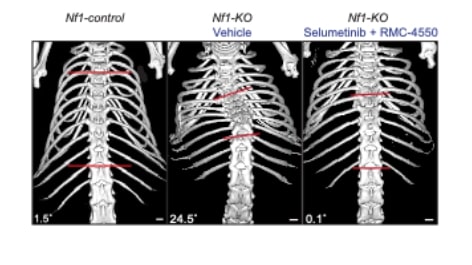
Researchers from France used an Nf1-KO mouse model to study how genetic changes linked to neurofibromatosis type 1 affect spinal development, leading to progressive curvature of the spine.
Researchers identify bone-forming cells as the driver of scoliosis caused by a genetic disorder, which can be prevented by medications.
CHINA, January 14, 2026 /EINPresswire.com/ -- In a new study, researchers from France have revealed why people with neurofibromatosis type 1 (NF1) often develop serious spine problems, such as scoliosis. Their findings show that faulty bone-forming cells cause the spine to grow abnormally over time. In mice, drugs that blocked an overactive cell signaling pathway were able to stop these spine deformations, suggesting that existing medicines could one day help prevent spinal deformities in people with NF1.Spinal deformities such as scoliosis and kyphosis are among the most serious complications of neurofibromatosis type 1 (NF1), a genetic disorder that affects about one in 3,000 people. These deformities often begin in childhood, worsen rapidly, and can lead to chronic pain, reduced mobility, and may require major surgery. Despite their frequency and severity, there are currently no approved drug treatments to prevent NF1-related spinal deformity.
In a new study published in Volume 13, Issue 103 of the journal Bone Research on December 16, 2025, a research team lead by Dr. Céline Colnot from Univ Paris Est Creteil in France set out to identify the cellular origin and biological mechanism behind this condition. They used a genetically engineered mouse model, known as the Prss56-Nf1 knockout mouse, which reproduces multiple NF1 symptoms, including tumors, bone abnormalities, and spinal curvature.
Using high-resolution micro-CT imaging, the researchers showed that the mice developed progressive spinal deformities beginning in adulthood, with vertebral changes closely resembling those seen in patients with NF1. By genetically labeling affected cells, the team traced the abnormalities to an unexpected source: bone-forming osteoblasts carrying mutations in the NF1 gene.
“Our data show that NF1-deficient osteoblasts accumulate in the vertebrae and are directly linked to the severity of the spinal curvature,” says Dr. Colnot. “The more mutant bone cells present, the more pronounced the deformity becomes.”
Further analyses revealed that these osteoblasts remain locked in an abnormally active state due to persistent activation of the RAS-MAPK signaling pathway, which regulates cell growth and differentiation. As a result, bone formation and resorption become imbalanced, leading to excessive and disorganized bone buildup within the spine.
“These cells continue to proliferate and fail to mature properly,” says Dr. Colnot. “Over the time, this disrupts the normal architecture of the vertebrae and contributes to spinal curvature.”
Because the RAS–MAPK pathway is already targeted by drugs used to treat certain NF1-related tumors, the researchers tested whether blocking this signal could prevent spinal deformity. When adult mutant mice were treated with a combination of selumetinib and RMC-4550, MEK/SHP2 inhibitors, the progression of spinal deformities was halted.
“Pharmacological inhibition of this pathway prevented spine deformity in our model,” the authors note, highlighting the potential of repurposing existing drugs for NF1-related skeletal disease.
The researchers caution that their findings are limited to mice and further studies are needed to determine whether similar mechanisms drive spinal deformity in people with NF1. Nonetheless, their work offers hope for understanding, and eventually treating, a condition that currently leaves patients with few options beyond monitoring and surgery.
***
Reference
Title of original paper: Pharmacological inhibition of RAS pathway alleviates spine deformity in a mouse model of neurofibromatosis type 1
Journal: Bone Research
DOI: https://doi.org/10.1038/s41413-025-00492-3
Yini Bao
Bone Research Editorial Office
+862885546461 ext.
email us here
Visit us on social media:
X
Legal Disclaimer:
EIN Presswire provides this news content "as is" without warranty of any kind. We do not accept any responsibility or liability for the accuracy, content, images, videos, licenses, completeness, legality, or reliability of the information contained in this article. If you have any complaints or copyright issues related to this article, kindly contact the author above.
