

Folding Bike Market to Reach USD 1,725.34 Million by 2032, Expanding at 10.3% CAGR, Reports Maximize Market Research
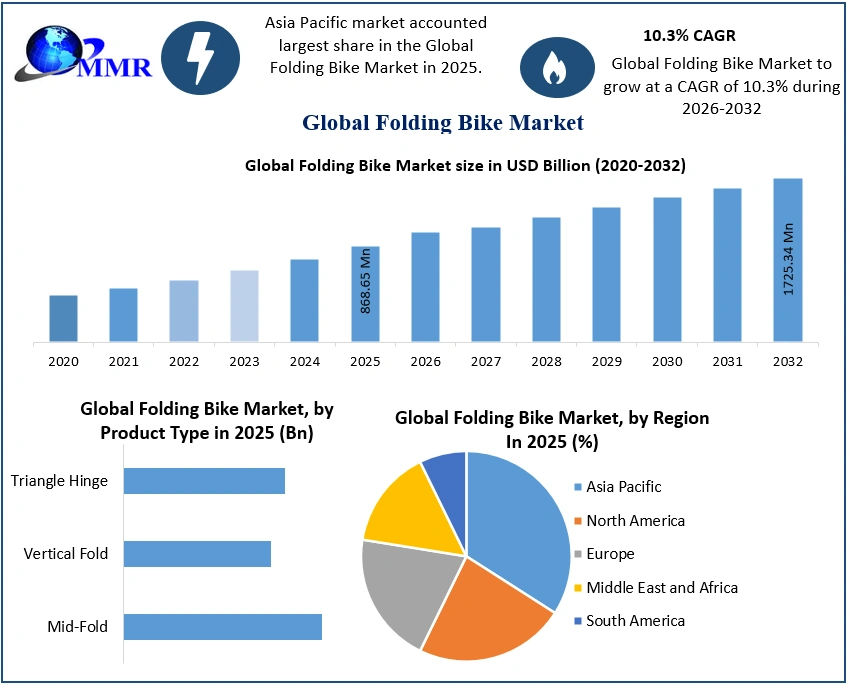
Folding Bike Market graph
Folding Bike Market was valued at USD 868.65 Million in 2025 and is projected to reach USD 1,725.34 Million by 2032, growing at a CAGR of 10.3%.
Urban density is not a constraint but catalyst, Maximize Market Research confirms within folding bike adoption dynamics.”
NEW YORK, NY, UNITED STATES, February 24, 2026 /EINPresswire.com/ -- Folding bike market was valued at USD 868.65 million in 2025 and is projected to reach USD 1,725.34 million by 2032, expanding at a CAGR of 10.3%. Growth momentum reflects electrification trends, transit integration policies, and increasing demand for compact mobility solutions across dense urban corridors.— Maximize Market Research
Global folding bike market is transitioning from space-saving convenience to transit-synchronized mobility infrastructure. Demand is increasingly shaped by metro carriage policies, compact housing expansion, and first-mile connectivity gaps Battery-assisted compact bikes are expanding nearly 1.6x faster than conventional variants, driven by rail-linked suburban commuters.
Get Full PDF Sample Copy of Report: (Including Full TOC, List of Tables & Figures, Chart) @ https://www.maximizemarketresearch.com/request-sample/14732/
Folding Bike Market Drivers: Urban Density, Transit Policy Alignment, and Sustainable Commuting Economics
Urban density is quietly reshaping how cities think about movement. As apartments shrink and storage space becomes limited, compact mobility solutions are no longer optional conveniences—they are becoming practical necessities. In cities like Paris, cycling infrastructure expansion ahead of the 2024 Olympics did more than improve roads; it normalized multimodal commuting. Rail carriage allowances and carbon-neutral policy frameworks are reinforcing demand patterns that appear increasingly stable rather than seasonal.
Folding Bike Market Restraints: Pricing Sensitivity, Policy Fragmentation, and Supply Volatility
Yet the adoption curve is not frictionless. Affordability remains a real constraint, particularly in price-sensitive commuter clusters where premium battery-assisted models stretch household budgets. Policy inconsistency across transit systems also complicates integration. Add lithium cost swings—visible during the 2023 battery correction cycle—and margin predictability becomes harder to sustain. Even technical inconsistencies in folding mechanisms can reduce long-term servicing confidence.
Folding Bike Market Opportunities: Smart City Investments and Subscription Mobility Models
Opportunities are emerging where policy and infrastructure align. Smart city programs are creating structured pathways for compact mobility adoption, especially when transit incentives and employer commuter benefits work together. Singapore’s Smart Nation initiatives illustrate how coordinated infrastructure planning can improve multimodal cycling integration. Meanwhile, subscription-based access models are gradually shifting revenue logic from one-time transactions toward recurring commuter engagement.
Folding Bike Market Challenges: Competitive Saturation and Margin Compression
Competition is intensifying, particularly as lower-cost regional manufacturers expand distribution reach. As feature sets converge, pricing differentiation becomes harder to defend. At the same time, compliance requirements linked to IoT integration increase operational complexity. Shared mobility platforms, including fleet expansions across European corridors, introduce additional substitution dynamics that reshape demand expectations across major urban hubs.
Folding Bike Market Trends: Electrification, Infrastructure Synchronization, and Predictable Commuter Behavior
Electrification is redefining the battery-assisted compact mobility segment by extending commuter range while preserving storage efficiency. In 2024, Japan’s JR East introduced reserved bicycle spaces on select Shinkansen routes, signaling stronger rail integration for compact bikes. Policy alignment and commuter analytics are strengthening infrastructure-driven demand predictability across the folding bicycle competitive landscape.
Folding Bike Market Regional Analysis
Asia-Pacific Drives Structural Scaling
Asia-Pacific remains central to foldable bicycle adoption, driven by dense housing and transit-oriented city planning.
Limited storage space and metro-dependent commuting make compact bikes practical daily solutions.
Policy shifts, such as Seoul’s expanded bike-carry access, further encourage battery-assisted model uptake across integrated rail corridors.
Europe Anchors Institutional Adoption
Europe reflects infrastructure-led maturity within the folding bicycle market.
Carriage-compatible rail systems, sustainability mandates, and programs such as Germany’s Deutschland ticket are indirectly strengthening rail-linked cycling adoption.
Leasing models and bundled service ecosystems are reshaping the folding bicycle competitive landscape toward lifecycle integration.
North America Shows Corridor-Driven Expansion
North America shows corridor-driven expansion, with adoption concentrated in dense transit hubs.
In Canada, Vancouver advanced cycling-transit integration near SkyTrain stations, while employer-backed mobility programs continue improving subscription-based revenue predictability across the electric folding bike market.
Folding Bike Market Segmentation Analysis by Product Type, Drive Type, Price Range, Application, and Distribution Channel
Urban infrastructure shapes segmentation in the folding bike space more than simple product variety. Mid-fold designs remain popular because their frame stability handles uneven city roads with greater confidence. Vertical-fold models, however, are increasingly chosen in micro-apartment environments where storage space, hallway width, and elevator access genuinely influence buying decisions. Meanwhile, triangle hinge configurations appeal to performance-focused commuters who prioritize efficient power transfer without sacrificing compact portability.
Within drive types, conventional bikes serve dense metro corridors, whereas the electric folding bike market scales in suburban-to-rail ecosystems where assisted range offsets extended commute distances. Economy pricing drives volume stability, while premium tiers integrate lightweight alloys and smart-lock systems to protect margins. Commercial fleet applications are expanding 3–4 percentage points faster annually than sports usage, reflecting institutional adoption over recreational cycling, and online channels increasingly capture subscription-based commuter conversions across the folding bike market growth trajectory.
By Product Type
Mid-Fold
Vertical Fold
Triangle Hinge
By Drive Type
Conventional
Electric
By Price Range
Low
Economy
Premium
By Application
Sports
Fitness
Commercial
Others
By Distribution Channel
Offline
Online
Get Full PDF Sample Copy of Report: (Including Full TOC, List of Tables & Figures, Chart) @ https://www.maximizemarketresearch.com/request-sample/14732/
Competitive Landscape
Competitive dynamics in the foldable bicycle space are increasingly defined by operational relevance rather than portfolio breadth. In North America, Montague and Schwinn emphasize full-ride geometry to maintain commuter confidence, while Helix differentiates through lightweight modular engineering. Across Europe, Brompton and Birdy benefit from regulatory familiarity and rail compatibility.
In Asia-Pacific, competitive positioning is shaped by manufacturing scale and supply responsiveness. Pacific Cycles and XDS leverage OEM capacity to serve dense commuter corridors were price accessibility influences adoption velocity. Meanwhile, in Latin America and the Middle East, Caloi and GoBike prioritize dealer expansion and fleet integration.
Folding Bike Market Key Developments 2025: Brompton, Pacific Cycles, Montague, and XDS Drive Growth Momentum
On 18 March 2025, Brompton launched its upgraded electric C-Line platform across major European rail corridors, improving battery efficiency by 15% and strengthening folding bike market growth visibility within commuter-led demand cycles.
On 07 May 2025, Pacific Cycles expanded OEM production capacity in Taiwan by 20%, enhancing supply responsiveness and reinforcing global folding bike market size scalability across Asia-Pacific transit-linked corridors.
On 22 July 2025, Montague introduced a performance-oriented mid-fold series targeting urban professionals, supporting premium margin expansion and diversifying folding bike market trends toward engineering-driven differentiation.
On 11 September 2025, XDS deployed an integrated distribution partnership across Southeast Asia, widening electric model penetration and improving regional folding bike market forecast stability through corridor-based volume consolidation.
Folding Bike Key Players
Montague
Allen Sports
Schwinn
Vilano
Retrospec
Helix
Brompton
Strida
Birdy Bike
Pacific Cycles
XDS
Ming Cycle
Phoenix Bike
Caloi
Durban Bikes
Totem Bikes
Dropp Bikes
Giramondo
GoBike
Bike Friday
Tornado
Giramondo
Cyrusher
Dahon
Tern Bicycles
Giant Manufacturing Co. Ltd.
Decathlon
Raleigh Bikes
Gocycle
Brompton Electric
Get access to the full description of the report @ https://www.maximizemarketresearch.com/market-report/global-folding-bikes-market/14732/
FAQ’s
What is the market estimation of the folding bike market by 2032?
Ans: Based on current industry assessments, the folding bike market was valued at about USD 868.65 million in 2025 and is expected to approach USD 1.7 billion by 2032. The projected 10.3% CAGR reflects steady structural adoption rather than short-term retail spikes.
Which region leads the global folding bike market forecast?
Ans: Asia-Pacific continues to lead, largely because dense housing and metro-dependent commuting create practical demand for compact mobility. Strong OEM production capacity in the region further supports consistent market expansion across transit-linked urban corridors.
What restraints impact the folding bicycle competitive landscape?
Ans: Adoption is not without friction. Higher upfront pricing for battery-assisted models, lithium cost fluctuations, and inconsistent rail carriage policies across cities create integration challenges. Servicing complexity from non-standard folding mechanisms also affects long-term buyer confidence.
What trends will shape the folding bike market through 2032?
Ans: Electrification remains central, but the deeper shift lies in transit alignment and subscription-based access models. As cities synchronize rail systems with compact mobility solutions, demand patterns are becoming infrastructure-driven rather than purely consumer-led.
Analyst Perspective
Market discussions around folding bikes are gradually shifting tone. What was once categorized alongside lifestyle cycling products is increasingly being evaluated within urban transport planning conversations. In dense cities, the purchase decision is often practical: storage constraints, last-mile gaps, and rail carriage policies matter more than brand appeal. Electrification is reinforcing this shift, particularly where assisted range closes suburban-to-station distances. The more telling change, however, is competitive behavior. Companies are investing less in cosmetic differentiation and more in mechanical durability, regulatory compliance, and service integration—signals that compact mobility is being treated as infrastructure-adjacent rather than discretionary retail.
Related Reports
Flying Bikes Market: https://www.maximizemarketresearch.com/market-report/flying-bikes-market/148799/
BMX Bikes Market: https://www.maximizemarketresearch.com/market-report/bmx-bikes-market/124684/
Cruiser Bikes Market: https://www.maximizemarketresearch.com/market-report/cruiser-bikes-market/124665/
Electric Cargo Bikes Market: https://www.maximizemarketresearch.com/market-report/global-electric-cargo-bikes-market/66694/
Top Reports:
Purified Terephthalic Acid (PTA) Market size was valued at USD 65.12 Billion in 2024 and the total Purified Terephthalic Acid (PTA) revenue is expected to grow at a CAGR of 5.7 % from 2025 to 2032, reaching nearly USD 101.46 Billion. https://www.maximizemarketresearch.com/market-report/global-purified-terephthalic-acid-pta-market/29017/
The Adhesives and Sealants Market size was valued at USD 108.71 Billion in 2025 and the total Adhesives and Sealants revenue is expected to grow at a CAGR of 4.53% from 2026 to 2032, reaching nearly USD 148.23 Billion by 2032. https://www.maximizemarketresearch.com/market-report/global-adhesives-and-sealants-market/16978/
Smart Water Management Market size was valued at USD 18.62 Billion in 2024 and the total Global Smart Water Management Market revenue is expected to grow at a CAGR of 10.5% from 2025 to 2032, reaching nearly USD 41.39 Billion. https://www.maximizemarketresearch.com/market-report/global-smart-water-management-market/28269/
The Consumer Packaging Market size was valued at USD 274.75 Billion in 2024 and the total Consumer Packaging revenue is expected to grow at a CAGR of 5.9% from 2025 to 2032, reaching nearly USD 434.62 Billion. https://www.maximizemarketresearch.com/market-report/global-consumer-packaging-market/26857/
The Braiding Machine Market size was valued at USD 545.55 Million in 2023 and the total Braiding Machine revenue is expected to grow at a CAGR of 2.3% from 2024 to 2030, reaching nearly USD 639.68 Million. https://www.maximizemarketresearch.com/market-report/global-braiding-machine-market/88629/
About Maximize Market Research
Maximize Market Research is a global market research and business consulting firm delivering data-driven insights across the Folding Bike Market. Our folding bicycle industry analysis supports strategic decisions by evaluating market structure, folding bike market growth drivers, commuter behavior, transit integration dynamics, supply chain resilience, and competitive positioning across global urban mobility ecosystems.
Domain Focus – Automotive and Transportation
Within the Automotive and Transportation domain, Maximize Market Research provides in-depth intelligence across the Folding Bike Market, including electric folding bike adoption, multimodal commuting infrastructure, fleet mobility integration, and distribution channel evolution. Our expertise covers lifecycle engineering assessment, regional penetration analysis, and long-term folding bike market forecast modeling for institutional investors and mobility stakeholders.
Lumawant Godage
MAXIMIZE MARKET RESEARCH PVT. LTD.
+ +91 96073 65656
email us here
Visit us on social media:
LinkedIn
Instagram
Facebook
X
Legal Disclaimer:
EIN Presswire provides this news content "as is" without warranty of any kind. We do not accept any responsibility or liability for the accuracy, content, images, videos, licenses, completeness, legality, or reliability of the information contained in this article. If you have any complaints or copyright issues related to this article, kindly contact the author above.
