

Japan Long-Term Care Pharmaceutical Consumption Market to Reach US$24.99 Billion by 2033 | DataM Intelligence
Japan Long-Term Care Pharmaceutical Consumption Market
Japan Long-Term Care Pharmaceutical Consumption Market to reach US$24.99 Billion by 2033 at 6.4% CAGR, driven by aging population and LTCI support.
Japan’s elderly population surge is reshaping pharmaceutical demand, accelerating growth in cardiovascular, CNS, and chronic disease therapies across long-term care settings.”
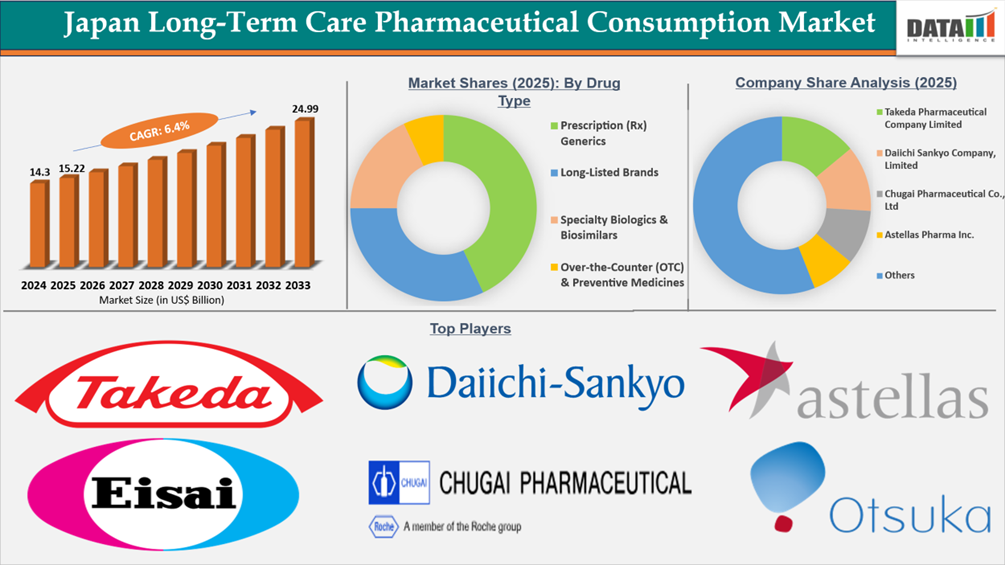
AUSTIN, TX, UNITED STATES, February 26, 2026 /EINPresswire.com/ -- According to DataM Intelligence, the Japan Long-Term Care Pharmaceutical Consumption Market reached US$14.3 Billion in 2024, rising to US$15.22 Billion in 2025, and is expected to reach US$24.99 Billion by 2033, growing at a CAGR of 6.4% from 2026 to 2033. This growth trajectory reflects structural demographic changes, enhanced long-term care infrastructure, and supportive government reimbursement policies under the Long-Term Care Insurance (LTCI) system. The cardiovascular drug segment currently leads the market due to high incidences of hypertension, stroke, and heart disease among Japan’s elderly population. Geographically, metropolitan regions such as Tokyo and Osaka dominate pharmaceutical consumption because of higher elderly population density, advanced healthcare infrastructure, and concentration of long-term care facilities.— DataM Intelligence
Japan’s long-term care pharmaceutical consumption market is experiencing steady expansion, driven by the country’s rapidly aging demographic structure and rising burden of chronic illnesses. Long-term care (LTC) services in Japan ranging from nursing homes and assisted living facilities to home-based elderly care rely heavily on continuous pharmaceutical therapy to manage chronic conditions, prevent complications, and improve quality of life among older adults. Cardiovascular drugs, central nervous system (CNS) therapies, anti-diabetics, anti-infectives, and pain management medications form the backbone of pharmaceutical consumption in long-term care settings. The growing prevalence of multimorbidity among elderly patients has led to increased polypharmacy, making medication management a critical component of the healthcare continuum.
Key Highlights from the Report:
➤ The market is projected to grow from US$15.22 Billion in 2025 to US$24.99 Billion by 2033 at a CAGR of 6.4%.
➤ Rapid population aging in Japan is the primary catalyst for increasing long-term care pharmaceutical consumption.
➤ Cardiovascular and CNS drugs account for the largest market share due to high chronic disease prevalence.
➤ Urban regions dominate consumption owing to higher concentration of elderly care institutions.
➤ Government-backed LTCI reimbursement ensures steady pharmaceutical demand.
➤ Technological integration in medication management is improving adherence and optimizing drug utilization.
➢ Get a Exclusive Sample PDF Of This Report (Get Higher Priority for Corporate Email ID):- https://www.datamintelligence.com/download-sample/japan-long-term-care-pharmaceutical-consumption-market
Recent Developments:
October 2025: Leading Japanese pharmaceutical companies expanded production of dementia and Alzheimer’s therapies in response to Japan’s rapidly aging population. With more than 29% of the population aged 65 and above, demand for cognitive disorder medications continues to rise across long-term care facilities and home-care settings.
September 2025: The Ministry of Health, Labour and Welfare announced updated reimbursement guidelines under Japan’s Long-Term Care Insurance (LTCI) system, encouraging the use of cost-effective generic drugs in elderly care institutions. The move aims to manage national healthcare expenditure while ensuring sustained pharmaceutical access.
August 2025: Several domestic manufacturers increased supply of polypharmacy management solutions, including combination therapies targeting hypertension, diabetes, and cardiovascular diseases conditions highly prevalent among long-term care residents. Digital medication adherence tools were also integrated into care facilities.
June 2025: Regulatory authorities accelerated approval pathways for innovative geriatric formulations, including easy-to-swallow tablets and transdermal patches, improving compliance among elderly patients with swallowing difficulties and cognitive impairment.
Mergers & Acquisitions:
November 2025: A major Japanese pharmaceutical firm acquired a specialty geriatric drug developer to strengthen its portfolio in neurodegenerative and chronic disease management therapies tailored for long-term care populations.
September 2025: A global healthcare company expanded its footprint in Japan through the acquisition of a regional generic drug manufacturer, enhancing supply chain capabilities and affordability of essential medicines in nursing homes and assisted living centers.
July 2025: A multinational life sciences group partnered with a Japanese long-term care service provider to integrate pharmaceutical management systems with elderly care operations, improving medication monitoring and reducing adverse drug events.
May 2025: A leading medical technology company acquired a digital health startup specializing in AI-driven medication adherence platforms, enabling predictive analytics for pharmaceutical consumption trends in Japan’s institutional elderly care sector.
Competitive Landscape
Takeda Pharmaceutical Company Limited
Daiichi Sankyo Company, Limited
Astellas Pharma Inc.
Eisai Co., Ltd.
Otsuka Pharmaceutical Co., Ltd.
Sumitomo Pharma Co., Ltd.
Shionogi & Co., Ltd.
Chugai Pharmaceutical Co., Ltd
Pfizer
Kyowa Kirin Co., Ltd.
Market Segmentation Analysis:
The Japan long-term care pharmaceutical consumption market can be segmented based on drug class, end-user setting, and distribution channel. By drug class, cardiovascular medications represent the dominant segment. Conditions such as hypertension, ischemic heart disease, atrial fibrillation, and stroke are highly prevalent among Japan’s elderly population. As a result, antihypertensives, statins, anticoagulants, and anti-arrhythmic drugs are widely prescribed in long-term care facilities and home healthcare settings.
The central nervous system (CNS) drug segment is also significant and continues to grow rapidly. Dementia, Alzheimer’s disease, Parkinson’s disease, depression, anxiety, and sleep disorders are common among elderly individuals receiving long-term care. Anti-dementia drugs, antidepressants, antipsychotics, and sedatives form a substantial share of pharmaceutical consumption. The increasing incidence of neurodegenerative diseases in Japan further strengthens this segment’s growth.
Other important drug categories include anti-diabetics, respiratory drugs, pain management medications, anti-infectives, and gastrointestinal drugs. Musculoskeletal disorders such as osteoporosis and arthritis drive demand for analgesics and bone-health therapies. Additionally, elderly patients are more susceptible to infections, supporting consistent use of antibiotics and antiviral drugs within LTC settings.
Based on end-users, long-term care facilities including nursing homes and assisted living centers hold a major share of pharmaceutical consumption due to structured medication administration and monitoring systems. Home-based long-term care services represent a fast-growing segment as Japan promotes aging-in-place policies. Hospital-based long-term care units also contribute significantly, particularly for patients requiring rehabilitation or post-acute care.
Distribution channels include hospital pharmacies, retail/community pharmacies, and specialized long-term care pharmacies. Community pharmacies play a vital role in dispensing medications and providing adherence support, while automated medication packaging systems are gaining popularity to reduce errors in elderly medication regimens.
Looking For A Detailed Full Report? Get it here: https://www.datamintelligence.com/buy-now-page?report=japan-long-term-care-pharmaceutical-consumption-market
Regional Insights:
Regionally, the Kanto region including Tokyo and surrounding prefectures leads the Japan long-term care pharmaceutical consumption market. This dominance is attributed to a high concentration of elderly residents, advanced healthcare infrastructure, and a large number of long-term care institutions. The region’s robust pharmaceutical distribution network further strengthens consumption levels.
The Kansai region, particularly Osaka and Kyoto, also demonstrates strong market activity due to significant elderly population growth and well-developed healthcare services. Urbanized areas generally report higher pharmaceutical utilization because of better access to medical specialists and long-term care facilities.
Rural prefectures face logistical and workforce challenges; however, they exhibit high elderly population ratios. These areas are increasingly adopting telehealth solutions and home-delivery pharmacy services to bridge accessibility gaps. Northern regions such as Hokkaido experience strong demand for chronic disease management drugs, although distribution complexities influence overall consumption patterns.
Market Dynamics
Market Drivers
The most significant driver of the Japan long-term care pharmaceutical consumption market is demographic aging. Japan has one of the highest proportions of individuals aged 65 and above globally. Aging is strongly associated with chronic diseases such as cardiovascular disorders, diabetes, respiratory illnesses, and neurodegenerative conditions. The coexistence of multiple chronic illnesses increases long-term medication use and sustained pharmaceutical consumption.
The Long-Term Care Insurance (LTCI) system further stimulates pharmaceutical demand by ensuring reimbursement and structured access to medications. Continuous improvements in elderly healthcare infrastructure and expansion of long-term care facilities also contribute to rising drug utilization. Moreover, advancements in geriatric-focused formulations, including extended-release tablets and easy-to-swallow dosage forms, improve adherence and enhance market growth.
Market Restraints
Despite steady growth, regulatory pricing controls pose challenges. Japan’s pharmaceutical pricing revisions and cost-containment policies aim to manage national healthcare expenditure, which may limit revenue expansion for drug manufacturers. Additionally, concerns regarding polypharmacy and adverse drug reactions in elderly patients encourage periodic medication review and deprescribing strategies, potentially moderating excessive drug consumption.
Workforce shortages in long-term care settings may also affect medication management efficiency. The growing need for trained healthcare professionals to monitor complex drug regimens remains a critical operational challenge.
Market Opportunities
Opportunities lie in developing innovative therapies targeting dementia, Alzheimer’s disease, and age-related chronic conditions. Personalized medicine approaches tailored to geriatric patients present strong growth potential. Expansion of digital health technologies such as AI-powered medication monitoring and automated dispensing systems can improve adherence and streamline pharmaceutical consumption.
Home healthcare expansion offers another promising avenue. As Japan increasingly promotes community-based elderly care, pharmaceutical companies can capitalize on home-delivery models and adherence-support services. Research collaborations and clinical innovation in neurodegenerative disease management further open avenues for long-term market growth.
Get Customization in the report as per your requirements: https://www.datamintelligence.com/customize/japan-long-term-care-pharmaceutical-consumption-market
Reasons to Buy the Report:
✔ Detailed market valuation from 2024 to 2033 with CAGR insights.
✔ Comprehensive segmentation analysis across drug classes and end-users.
✔ In-depth coverage of drivers, restraints, and emerging opportunities.
✔ Regional assessment highlighting dominant consumption areas.
✔ Competitive landscape insights with recent strategic developments.
Frequently Asked Questions (FAQs):
◆ How big is the Japan Long-Term Care Pharmaceutical Consumption Market in 2024 and what is its forecast to 2033?
◆ What is the projected CAGR of the Japan Long-Term Care Pharmaceutical Consumption Market from 2026 to 2033?
◆ Which drug segment dominates the Japan long-term care pharmaceutical consumption market?
◆ Who are the major companies operating in Japan’s long-term care pharmaceutical sector?
◆ Which region in Japan leads pharmaceutical consumption in long-term care facilities?
Conclusion:
The Japan Long-Term Care Pharmaceutical Consumption Market is poised for sustained expansion, growing from US$14.3 Billion in 2024 to an expected US$24.99 Billion by 2033 at a CAGR of 6.4%. Demographic aging, rising chronic disease prevalence, and structured reimbursement frameworks form the backbone of this growth. Cardiovascular and CNS drug segments continue to dominate consumption patterns, while urban regions lead due to advanced healthcare infrastructure.
Although regulatory pricing controls and polypharmacy concerns present challenges, ongoing innovation in geriatric medicine and digital healthcare integration provide strong opportunities. As Japan continues to refine its long-term care ecosystem, pharmaceutical consumption will remain central to delivering quality, accessible, and sustainable elderly healthcare services.
Related Reports:
Long Term Care Market Size
Japan Point-of-Care Diagnostics Market
Sai Kiran
DataM Intelligence 4market Research LLP
+1 877-441-4866
email us here
Visit us on social media:
LinkedIn
YouTube
X
Legal Disclaimer:
EIN Presswire provides this news content "as is" without warranty of any kind. We do not accept any responsibility or liability for the accuracy, content, images, videos, licenses, completeness, legality, or reliability of the information contained in this article. If you have any complaints or copyright issues related to this article, kindly contact the author above.
