

Variable Refrigerant Flow System Market Surges Driven by Energy Efficiency and Smart Building Demand
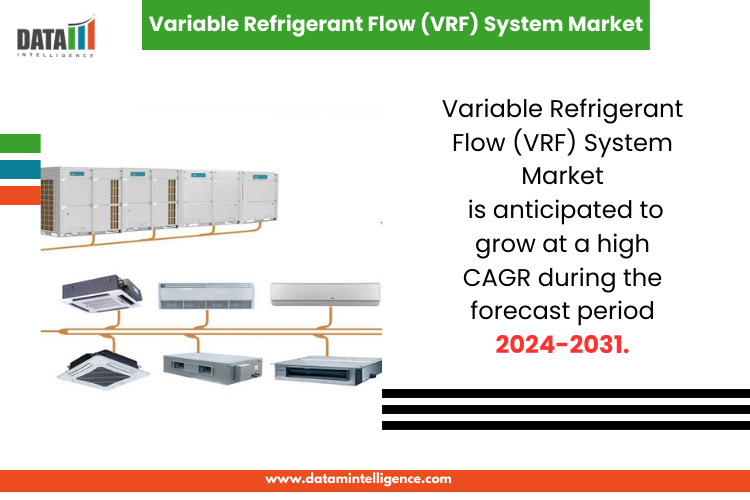
Variable Refrigerant Flow (VRF) System Market
Heat recovery VRF systems and Asia-Pacific growth accelerate adoption amid urbanization and sustainability regulations.
As cities expand and energy costs rise, VRF systems are redefining HVAC efficiency with smart, scalable, and sustainable cooling solutions.”
AUSTIN, TX, UNITED STATES, February 27, 2026 /EINPresswire.com/ -- According to DataM Intelligence, the global Variable Refrigerant Flow (VRF) System Market is poised for substantial expansion, with projections indicating robust growth through 2031 driven by urbanization and sustainability mandates. Key growth drivers include escalating demand for energy-efficient HVAC solutions amid rising electricity costs, stringent energy codes like those in Japan and Europe promoting low-GWP refrigerants, and rapid commercial construction in emerging economies.— DataM Intelligence
𝗚𝗲𝘁 𝗮 𝗦𝗮𝗺𝗽𝗹𝗲 𝗣𝗗𝗙 𝗕𝗿𝗼𝗰𝗵𝘂𝗿𝗲 𝗼𝗳 𝘁𝗵𝗲 𝗥𝗲𝗽𝗼𝗿𝘁 (𝗨𝘀𝗲 𝗖𝗼𝗿𝗽𝗼𝗿𝗮𝘁𝗲 𝗘𝗺𝗮𝗶𝗹 𝗜𝗗 𝗳𝗼𝗿 𝗮 𝗤𝘂𝗶𝗰𝗸 𝗥𝗲𝘀𝗽𝗼𝗻𝘀𝗲):
https://www.datamintelligence.com/download-sample/variable-refrigerant-flow-system-market
The leading segment is heat recovery VRF systems, favored for their ability to transfer heat between zones for optimal efficiency in diverse applications such as hotels and hospitals, while Asia-Pacific dominates geographically with over 52% market share due to massive infrastructure projects in China, India, and Japan, bolstered by local manufacturing hubs and government green building incentives.
Key Highlights from the Report
➤ The VRF system market is Expected to grow at a high CAGR during the forecast period 2024-2031.
➤ Asia-Pacific holds 52.7% revenue share, driven by China's manufacturing and India's data center boom.
➤ Heat recovery systems lead due to superior zoning and simultaneous heating/cooling capabilities.
➤ Commercial end-users dominate, accounting for the largest share amid urbanization and office expansions.
➤ Control systems grow fastest at 10.9% CAGR, integrating IoT for smart building management.
➤ Key players like Daikin and Mitsubishi innovate with R-32 refrigerants to meet low-GWP regulations.
Market Segmentation
In the Variable Refrigerant Flow (VRF) system market, segmentation by system type distinguishes heat pump variants, which cycle between cooling and heating modes, from heat recovery systems that enable simultaneous operations by recovering excess heat for reuse, and hybrid or water-cooled models suited for large-scale integrations. Heat recovery holds prominence for its versatility in multi-zone commercial setups, while all-electric VRF gains traction in residential retrofits for simplified installation.
By capacity, the market spans ≤10 kW for small residential units, 11-18 kW as the revenue leader for mid-sized offices and retail (38.5% share), 19-24 kW for medium enterprises, and >24 kW systems exploding at 11.1% CAGR for data centers and industrial facilities demanding high-capacity, electrified cooling.
Component-wise, outdoor units command 47% share housing critical compressors and heat exchangers, indoor units offer diverse cassette, ducted, and wall-mounted options, while control systems and accessories like piping drive smart connectivity growth.
End-user categories feature commercial buildings as the frontrunner with hotels, offices, and retail prioritizing zonal control, followed by residential for luxury homes, industrial for factories, and public/institutional sectors like schools and hospitals seeking energy savings.
Looking For A Detailed Full Report? Get it here:
https://www.datamintelligence.com/buy-now-page?report=variable-refrigerant-flow-system-market
Regional Insights
Asia-Pacific spearheads the VRF system market with 52.7% global revenue in 2024, propelled by China's export manufacturing clusters adopting VRF for factories, Japan's April 2025 R-32 low-GWP mandate, India's data center surge, and Australia's stringent energy codes spurring retrofits; robust supply chains and subsidies cement its dominance.
North America experiences steady uptake in commercial renovations and smart buildings, supported by U.S. green incentives and Canada's cold-climate adaptations, though high upfront costs temper residential penetration. Europe advances via EU energy directives favoring heat recovery VRF in offices and public structures, with Germany and the UK leading in low-carbon transitions.
Latin America and Middle East & Africa emerge as high-growth pockets; Latin America's shift to efficient cooling in commercial spaces benefits from incentives, while MEA's infrastructure boom, tourism in UAE/Saudi Arabia, and hot climates necessitate VRF for hotels and malls.
Get Customization in the report as per your requirements:
https://www.datamintelligence.com/customize/variable-refrigerant-flow-system-market
Market Drivers
Rising energy costs and sustainability pressures propel VRF adoption, as these systems deliver up to 30-50% savings over traditional HVAC by modulating refrigerant precisely to zone needs, aligning with global net-zero goals and corporate ESG mandates. Urbanization and commercial real estate booms, particularly in Asia's megacities, demand flexible multi-zone cooling for high-rises, offices, and hospitality, where VRF's quiet operation and aesthetics outperform split systems.
Market Restraints
High initial installation costs, often 20-30% above conventional systems due to complex piping and advanced controls, deter small-scale residential and budget-conscious projects, especially in developing regions lacking skilled technicians. Regulatory shifts to low-GWP refrigerants like R-32 raise compliance expenses and require system redesigns, while supply chain disruptions for components slow scalability.
Market Opportunities
Expansion into data centers and EV manufacturing plants offers vast potential, as >24 kW VRF handles high heat loads efficiently without chilled water infrastructure, tapping into electrified industrial trends. Retrofitting aging buildings in Europe and North America for smart IoT-integrated VRF aligns with renovation subsidies, while residential penetration grows in premium housing with hybrid models blending air-source efficiency.
Reasons to Buy the Report
✔ Comprehensive market sizing and forecasts from DataM Intelligence provide actionable insights for 2024-2031.
✔ Detailed segmentation analysis reveals high-growth niches like heat recovery and Asia-Pacific dominance.
✔ In-depth competitive landscape tracks key players' strategies and innovations.
✔ Identifies drivers, restraints, and opportunities for strategic planning.
✔ Regional breakdowns enable targeted expansion in emerging markets.
Frequently Asked Questions (FAQs)
◆ How big is the Variable Refrigerant Flow (VRF) System Market?
◆ Who are the key players in the global Variable Refrigerant Flow (VRF) System Market?
◆ What is the projected growth rate of the VRF system market?
◆ What is the Variable Refrigerant Flow (VRF) System Market forecast for 2031?
◆ Which region dominates the VRF system industry through the forecast period?
Company Insights
Daikin Industries, Ltd.
Mitsubishi Electric Corporation
LG Electronics Inc.
Carrier Global Corporation
Johnson Controls International plc
Midea Group Co., Ltd.
Panasonic Corporation
Samsung Electronics Co., Ltd.
Fujitsu General Limited
Blue Star Limited
Recent Developments:
✅ In October 2025, Daikin Industries launched next-gen R-32 VRF systems with enhanced IoT controls for data centers, investing $150 million in production upgrades to meet low-GWP mandates.
✅ In September 2025, Mitsubishi Electric introduced heat recovery VRF hybrids for industrial applications, backed by $100 million in R&D for cold-climate efficiency amid Asia-Pacific expansions.
Conclusion
The Variable Refrigerant Flow (VRF) System Market stands at a pivotal juncture, propelled by technological advancements, energy efficiency imperatives, and global urbanization, positioning it for sustained double-digit growth through 2031. Stakeholders leveraging insights from DataM Intelligence and segment-specific opportunities in commercial and Asian markets will capture significant value in this dynamic HVAC landscape. As regulations tighten and smart buildings proliferate, VRF's zonal precision and sustainability edge solidify its role in future-proofing climate control infrastructure.
Sai Kiran
DataM Intelligence 4market Research LLP
+1 877-441-4866
sai.k@datamintelligence.com
Visit us on social media:
LinkedIn
YouTube
X
Legal Disclaimer:
EIN Presswire provides this news content "as is" without warranty of any kind. We do not accept any responsibility or liability for the accuracy, content, images, videos, licenses, completeness, legality, or reliability of the information contained in this article. If you have any complaints or copyright issues related to this article, kindly contact the author above.
