

Peptide Therapeutics Contract API Manufacturing Market to Reach USD $4.12 Billion by 2030 at 7.4% CAGR
Peptide Therapeutics Contract Active Pharmaceutical Ingredient (API) Manufacturing Market Report 2026
Peptide Therapeutics Contract Active Pharmaceutical Ingredient (API) Manufacturing Market Drivers & Restraints 2026
Peptide Therapeutics Contract Active Pharmaceutical Ingredient (API) Manufacturing Market Report 2026_Regions
The Business Research Company's Peptide Therapeutics Contract API Manufacturing Market Report 2026 – Market Size, Trends, And Global Forecast 2026-2035
LONDON, GREATER LONDON, UNITED KINGDOM, April 22, 2026 /EINPresswire.com/ -- "Peptide Therapeutics Contract Active Pharmaceutical Ingredient (API) Manufacturing market to surpass $4 billion in 2030. In comparison, the Pharmaceutical API market, which is considered as its parent market, is expected to be approximately $303 billion by 2030, with Peptide Therapeutics Contract Active Pharmaceutical Ingredient (API) Manufacturing to represent around 1% of the parent market. Within the broader Pharmaceuticals industry, which is expected to be $2,513 billion by 2030, the Peptide Therapeutics Contract Active Pharmaceutical Ingredient (API) Manufacturing market is estimated to account for nearly 0.2% of the total market value.
Which Will Be The Biggest Region In The Peptide Therapeutics Contract Active Pharmaceutical Ingredient (API) Manufacturing Market In 2030?
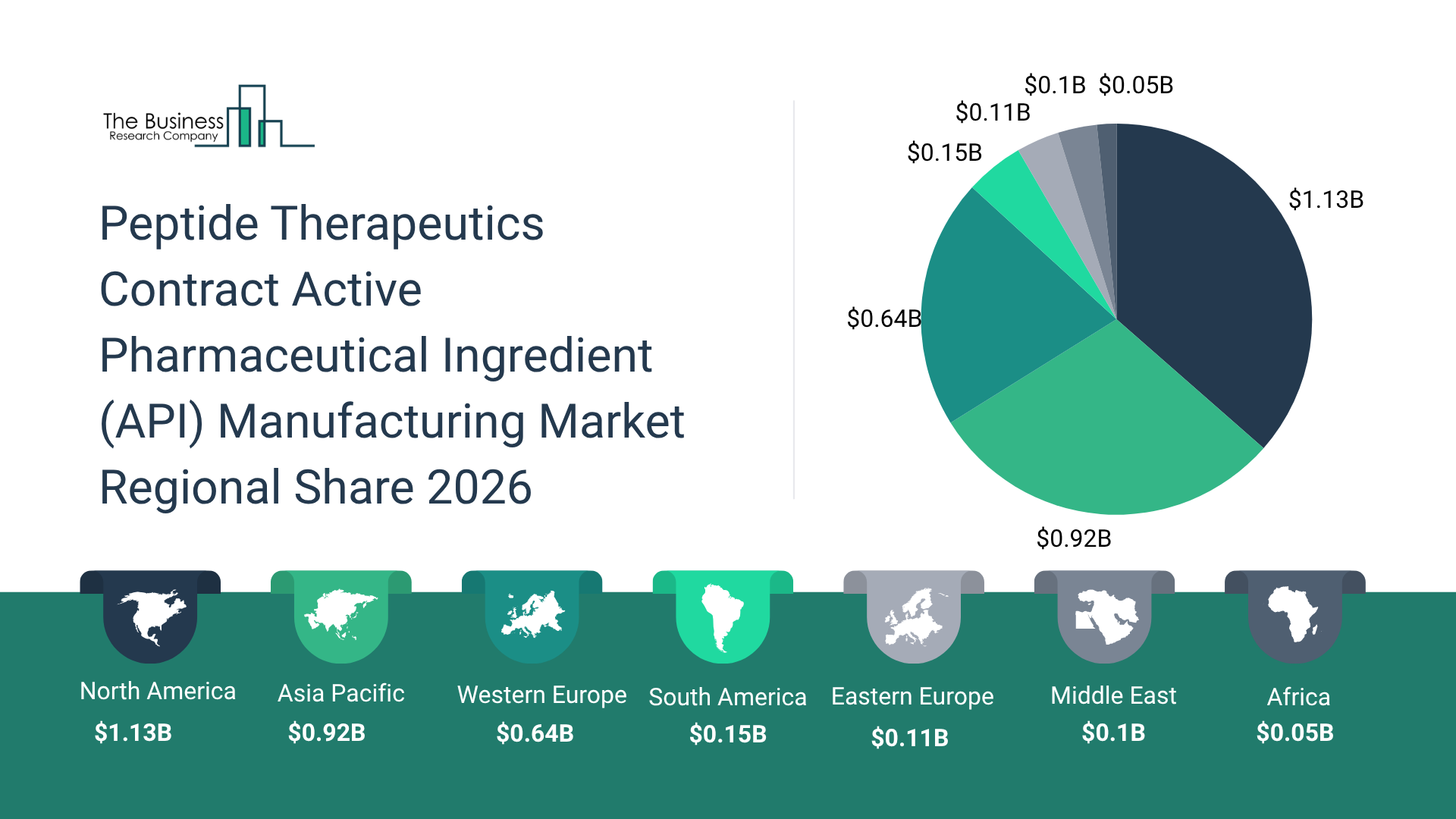
North America will be the largest region in the peptide therapeutics contract API manufacturing market in 2030, valued at $1.4 billion. The market is expected to grow from $1.1 billion in 2025 at a compound annual growth rate (CAGR) of 6%. The strong growth can be attributed to strong presence of specialized peptide-focused contract development and manufacturing organizations (CDMOs), increasing adoption of advanced purification and chromatography techniques, growing demand for complex and long-chain peptide production, strong regulatory expertise in handling high-potency APIs, and increasing investments in continuous manufacturing and process intensification technologies across the region.
Which Will Be The Largest Country In The Global Peptide Therapeutics Contract Active Pharmaceutical Ingredient (API) Manufacturing Market In 2030?
The USA will be the largest country in the peptide therapeutics contract active pharmaceutical ingredient (API) manufacturing market in 2030, valued at $1.3 billion. The market is expected to grow from $1.0 billion in 2025 at a compound annual growth rate (CAGR) of 6%. The strong growth can be attributed to leadership in advanced peptide purification and analytical capabilities, strong ecosystem of biotech startups and innovation hubs, increasing use of hybrid synthesis approaches combining chemical and biological methods, rising demand for personalized and precision medicine applications, and strong integration of digital manufacturing technologies and quality monitoring systems across API production facilities in the country.
Request A Free Sample Of The Peptide Therapeutics Contract API Manufacturing Market Report
https://www.thebusinessresearchcompany.com/sample_request?id=25870&type=smp&utm_source=EINPresswire&utm_medium=Paid&utm_campaign=Apr_PR
What Will Be The Largest Segment In The Peptide Therapeutics Contract Active Pharmaceutical Ingredient (API) Manufacturing Market In 2030?
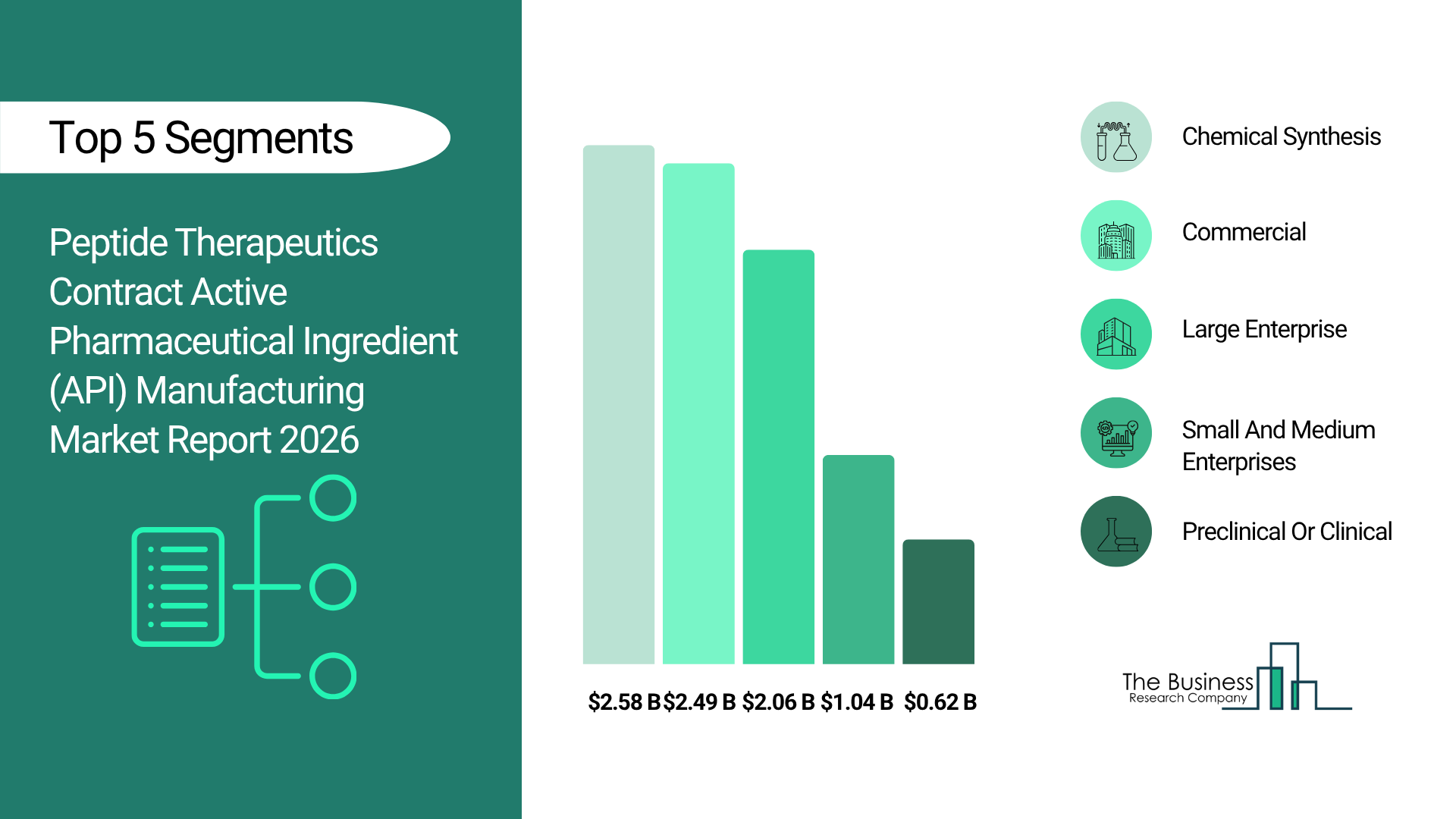
The peptide therapeutics contract active pharmaceutical ingredient (API) manufacturing market is segmented by scale of operation into preclinical or clinical and commercial. The commercial market will be the largest segment of the market, segmented by scale of operation, accounting for 80% or $3 billion of the total in 2030. The commercial market will be supported by increasing demand for large-batch and continuous production processes, growing need for supply chain reliability in marketed drugs, rising investments in dedicated peptide manufacturing facilities, increasing focus on cost optimization through process standardization, and strong emphasis on maintaining consistent product quality at scale.
The peptide therapeutics contract active pharmaceutical ingredient (API) manufacturing market is segmented by synthesis method into non-chemical synthesis and chemical synthesis. The chemical synthesis market will be the largest segment of the market segmented by synthesis method, accounting for 82% or $3 billion of the total in 2030. The chemical synthesis market will be supported by advancements in automated synthesizers and process control systems, increasing use of flow chemistry techniques, strong compatibility with complex peptide modifications, growing adoption of scalable and reproducible synthesis workflows, and continuous improvements in reaction efficiency and yield optimization.
The peptide therapeutics contract active pharmaceutical ingredient (API) manufacturing market is segmented by enterprise type into large enterprises and small and medium enterprises. The large enterprise market will be the largest segment of the market, segmented by enterprise type, accounting for 65% or $3 billion of the total in 2030. The large enterprise market will be supported by ability to invest in advanced manufacturing technologies, strong global supply chain networks, increasing focus on end-to-end service offerings from development to commercialization, growing adoption of digital quality management systems, and expansion of integrated CDMO service models.
What Is The Expected CAGR For The Peptide Therapeutics Contract Active Pharmaceutical Ingredient (API) Manufacturing Market Leading Up To 2030?
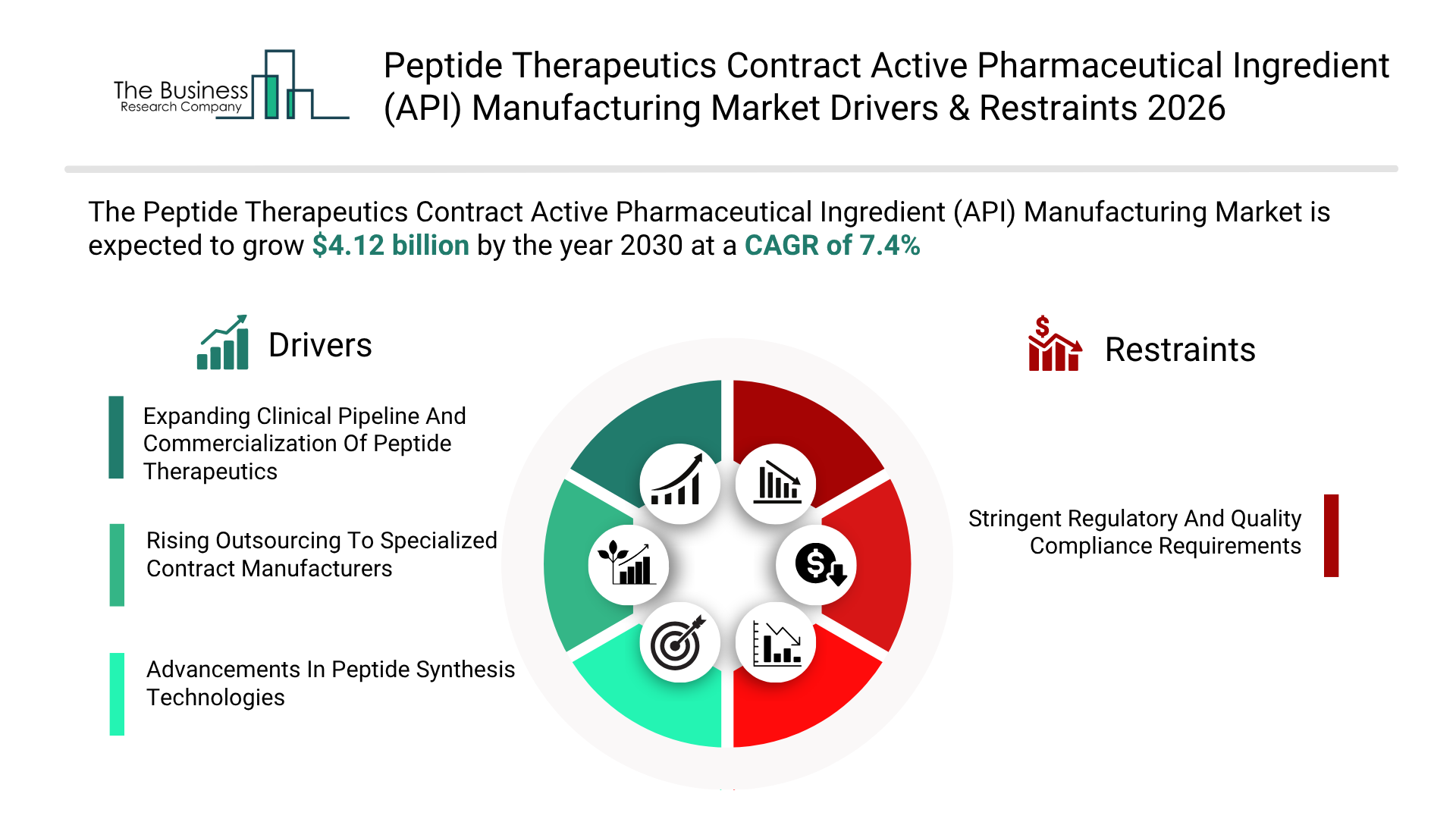
The expected CAGR for the peptide therapeutics contract active pharmaceutical ingredient (API) manufacturing market leading up to 2030 is 7%.
What Will Be The Growth Driving Factors In The Global Peptide Therapeutics Contract Active Pharmaceutical Ingredient (API) Manufacturing Market In The Forecast Period?
The rapid growth of the global peptide therapeutics contract active pharmaceutical ingredient (API) manufacturing market leading up to 2030 will be driven by the following key factors that are expected to reshape outsourcing strategies, manufacturing scalability, technological innovation, and commercialization capabilities across the biopharmaceutical industry.
Expanding Clinical Pipeline And Commercialization Of Peptide Therapeutics – The expanding clinical pipeline and commercialization of peptide therapeutics are expected to become a key growth driver for the peptide therapeutics contract API manufacturing market by 2030. The increasing number of peptide-based drug candidates advancing through clinical trials, particularly in metabolic disorders, oncology, and rare diseases, is driving demand for reliable and scalable API manufacturing. As more peptides receive regulatory approvals, the need for commercial-scale production is intensifying, prompting pharmaceutical companies to partner with specialized contract manufacturers. This trend is further supported by growing investment in peptide drug development and innovation. As a result, the expanding clinical pipeline and commercialization of peptide therapeutics are anticipated to contribute approximately 2.8% annual growth to the market.
Rising Outsourcing To Specialized Contract Manufacturers – The rising outsourcing to specialized contract manufacturers is expected to emerge as a major factor driving the expansion of the peptide therapeutics contract API manufacturing market by 2030. Pharmaceutical and biotechnology companies are increasingly shifting toward outsourcing to reduce capital investments, access advanced technical expertise, and accelerate time-to-market. Contract manufacturers offer specialized capabilities in peptide synthesis, purification, and scale-up that are difficult to develop in-house. Additionally, outsourcing provides operational flexibility and helps manage fluctuating production demands across clinical and commercial stages. Consequently, the rising outsourcing to specialized contract manufacturers is projected to contribute around 2.5% annual growth to the market.
Advancements In Peptide Synthesis Technologies – The advancements in peptide synthesis technologies are expected to act as a key growth catalyst for the peptide therapeutics contract API manufacturing market by 2030. Continuous improvements in solid-phase peptide synthesis (SPPS), hybrid synthesis methods, and process automation are enhancing production efficiency, yield, and scalability. These innovations enable manufacturers to produce longer, more complex peptides with higher purity and reduced production timelines. Furthermore, advancements in purification technologies and process optimization are lowering manufacturing costs and improving consistency. As technology adoption increases across contract manufacturers, overall production capabilities are strengthening. Therefore, the advancements in peptide synthesis technologies are projected to contribute approximately 2.0% annual growth to the market.
Access The Detailed Peptide Therapeutics Contract Active Pharmaceutical Ingredient (API) Manufacturing Market Report Here
https://www.thebusinessresearchcompany.com/report/peptide-therapeutics-contract-active-pharmaceutical-ingredient-api-manufacturing-global-market-report?utm_source=EINPresswire&utm_medium=Paid&utm_campaign=Apr_PR
What Are The Key Growth Opportunities In The Peptide Therapeutics Contract Active Pharmaceutical Ingredient (API) Manufacturing Market in 2030?
The most significant growth opportunities are anticipated in the preclinical or clinical market and the commercial market. Collectively, these segments are projected to contribute over $1.03 billion in market value by 2030, driven by increasing adoption of integrated CDMO service models, growing demand for flexible manufacturing capacity across development stages, rising investments in specialized peptide production facilities, expansion of global peptide supply chains, and increasing focus on rapid scale-up capabilities from clinical to commercial production. This surge reflects the evolution of advanced manufacturing ecosystems, improved scalability of peptide production, and growing alignment between drug development pipelines and manufacturing capabilities, fuelling transformative growth within the broader peptide therapeutics contract API manufacturing market.
The preclinical or clinical market is projected to grow by $0.3 billion, and the commercial market is projected to grow by $1.0 billion over the next five years, from 2025 to 2030.
Learn More About The Business Research Company
The Business Research Company (www.thebusinessresearchcompany.com) is a leading market intelligence firm renowned for its expertise in company, market, and consumer research. We have published over 17,500 reports across 27 industries and 60+ geographies. Our research is powered by 1,500,000 datasets, extensive secondary research, and exclusive insights from interviews with industry leaders.
We provide continuous and custom research services, offering a range of specialized packages tailored to your needs, including Market Entry Research Package, Competitor Tracking Package, Supplier & Distributor Package and much more.
Disclaimer: Please note that the findings, conclusions and recommendations that TBRC Business Research Pvt Ltd delivers are based on information gathered in good faith from both primary and secondary sources, whose accuracy we are not always in a position to guarantee. As such TBRC Business Research Pvt Ltd can accept no liability whatever for actions taken based on any information that may subsequently prove to be incorrect. Analysis and findings included in TBRC reports and presentations are our estimates, opinions and are not intended as statements of fact or investment guidance.
Contact Us:
The Business Research Company
Americas +1 310-496-7795
Europe +44 7882 955267
Asia & Others +44 7882 955267 & +91 8897263534
Email: info@tbrc.info
Follow Us On:
LinkedIn: https://in.linkedin.com/company/the-business-research-company"
Oliver Guirdham
The Business Research Company
+44 7882 955267
info@tbrc.info
Visit us on social media:
LinkedIn
Facebook
X
Legal Disclaimer:
EIN Presswire provides this news content "as is" without warranty of any kind. We do not accept any responsibility or liability for the accuracy, content, images, videos, licenses, completeness, legality, or reliability of the information contained in this article. If you have any complaints or copyright issues related to this article, kindly contact the author above.
